Infostealers Do Not Need Exploits. They Need Your LOLBAS.
Most infostealer alerts fire after browser data has already left the device. The execution chain that got it there, mshta, rundll32, PowerShell, a signed loader, was allowed to run. Here's what the data says about how infostealers actually operate and where application control changes the outcome.
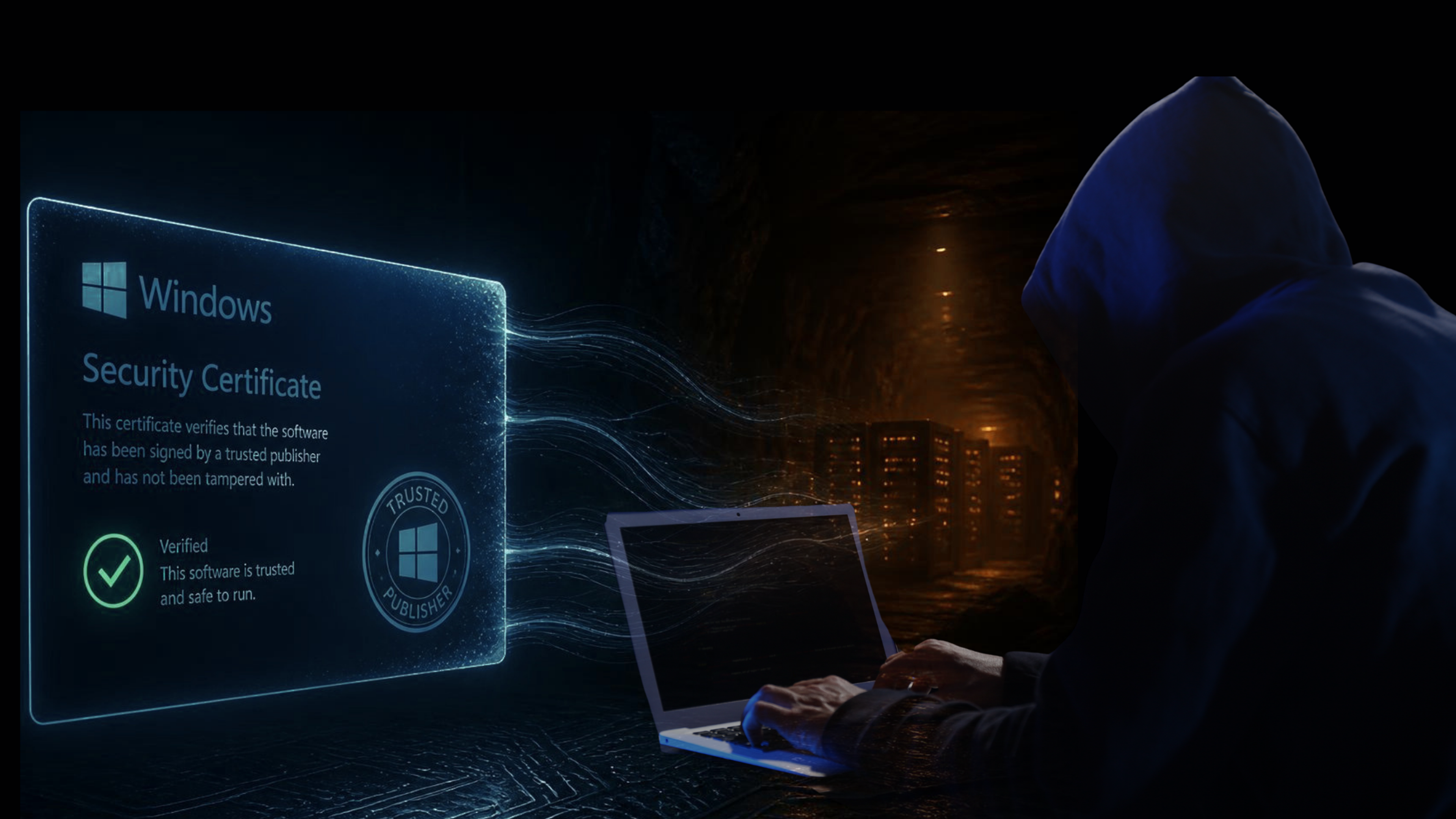
Most stealer alerts fire after browser data has already left the host. EDR is often correct when it names Lumma, Vidar, or StealC. What produced the log is usually a signed Windows binary (mshta, rundll32, PowerShell, or conhost) that was allowed to fetch and run a loader.

Scope
Ransomware.live's Infostealer Intelligence dashboard correlates Hudson Rock stealer logs with domains that later appeared as ransomware victims on that platform. Snapshot, August 2026: [15]
- 27,167 domains with stealer exposure
- 431,388 employees exposed
- 34,478,827 users exposed
- 20 stealer families

These totals are not global infection counts. They measure overlap between stealer logs and domains that later showed up as ransomware victims. RedLine is still the largest slice of that historical pile because older logs stay in the dataset after the family is disrupted. Treat the screenshot as a point in time and use the live dashboard for current figures.
Related reporting:
- Flashpoint: more than 11.1 million infected devices in 2025 and 7.4 million in H1 2026, about 1.7 billion credentials in six months. [1][2][3]
- SpyCloud: 642 million exposed credentials from 13.2 million infections in 2025. [16]
- CybelAngel: 54 percent of ransomware victims already had domain credentials in stealer logs before the attack. [17]
Loss figures are not filed as "Lumma." What can be cited:
- IBM Cost of a Data Breach: global average $4.44 million. Credential-based breaches about $4.67 million. [18]
- FBI IC3 / Constella summary of the 2025 Internet Crime Report: $16.6 billion to $20.9 billion in reported U.S. cybercrime losses. BEC about $3.0 billion. Infostealers are an input to ATO, BEC, and ransomware, not that entire figure. [17][19]
- Underground pricing: a commodity log is often around $10. A verified corporate password is tens of dollars. A working VPN or identity-provider session is often hundreds. Packaged initial access can reach the low thousands. [17][20]
The operational gap sits earlier than the family name. A signed copy of mshta or rundll32 is allowed to fetch a loader, and the resulting log can be sold before the SOC ticket has an owner. Application control is the control that can deny that execution. The policy question is whether those binaries are allowed to act as downloaders on a standard workstation.
Observed families, late 2024 to mid 2026
Family rankings move after every takedown. The table below is the set that actually moved volume in public reporting from late 2024 through mid 2026, not a permanent top five.
| Family | Why it mattered | Public reporting |
|---|---|---|
| Lumma (LummaC2) | Dominant in 2025 until the May 2025 disruption. Reappeared via clones such as Remus. | Recorded Future described it as the year's dominant threat. Microsoft sinkholed hundreds of thousands of hosts. Fake CAPTCHA and mshta chains were common. [4][5] |
| Vidar | Absorbed displaced affiliates. Flashpoint had it leading in early 2026. | Telegram and Steam dead-drop C2. Often delivered by Amadey. Also observed behind ClickFix and fake AI installers. [1][2][6] |
| StealC | Persistent MaaS family. Microsoft and partners disrupted StealC and Amadey infrastructure in June 2026. | Amadey loads plugins through rundll32, cmd, and PowerShell. Affiliates handle delivery. [6] |
| Acreed / ACR / Amatera | Filled the post-Lumma gap. Microsoft reported a surge against enterprise customers from April to June 2026. | Two documented ClickFix chains: WebDAV + rundll32, and mshta + in-memory PowerShell. Later WordlistLoader and EtherHiding. NetSupport in some follow-on activity. [7][8][9][10] |
| Rhadamanthys | Top five in 2025. Led for a period after Lumma, then a November 2025 disruption. | Premium MaaS. SEO-poisoned software. HTTPS with Tor fallback. Still observed in C2 reporting after the takedown. [1][4] |
RedLine was the leading family through 2024 until Operation Magnus in October 2024 took the panel and part of the affiliate base offline. It still appears in Hudson Rock-style log piles because those records are not removed when the panel dies. An older infection can still show a domain, an employee mailbox, and stolen session data. That is useful for exposure and credential hygiene. It is a weak basis for a 2026 prevention policy. Hash rules for a disrupted builder will not cover Vidar, StealC, Acreed, or the clone that shipped after the last takedown.
Affiliates also do not rewrite delivery when they switch builders. The reused pattern is ClickFix into mshta or rundll32, a loader injected into a Microsoft-signed host, a cheap log sold on Telegram, and a signed RMM (NetSupport, ScreenConnect, AnyDesk) if the access is worth more than the log. Durable controls target that shared execution set, not the brand on this month's builder.
Host chain

- Traffic. SEO-poisoned downloads, malvertising, cracked software, fake AI tools, or a compromised site injecting a fake CAPTCHA (ClearFake / ClickFix).
- User action. Run a fake installer, or paste a clipboard command into the Run dialog.
- Staging with LOLBAS.
powershell.exe,mshta.exe,rundll32.exe,conhost.exe,cmd.exe, sometimes curl.exe or msiexec.exe. - Loader. Amadey, CastleLoader, WordlistLoader, Emmenhtal, HijackLoader, PureCrypter. Injection into
MSBuild.exeis common. - Stealer. Browser databases, cookies, tokens, wallets, sometimes OneDrive and SharePoint files. The log is sent to C2. Many builds self-delete.
- Optional follow-on. NetSupport, ScreenConnect, AnyDesk, a clipper, or sale of the log into a ransomware affiliate panel.
Application control can allow or deny execution at steps 2 through 4, before the stealer runs. EDR typically operates at steps 5 and 6, when it can name the family, the C2, or an unexpected remote tool. That telemetry is useful for response. It does not revoke a cookie or token that has already left the host.
Microsoft made the same split in the ACR write-up: application control can restrict launching content from a remote resource using PowerShell, Python, mshta.exe, or rundll32.exe, especially from user-writable paths. [7][8] That is a WDAC policy decision, not new detection content.
Shared tradecraft
| Stage | Shared behavior | Tools | Constraint |
|---|---|---|---|
| Initial execution (ClickFix) | Fake CAPTCHA or error overlay copies a command. Victim uses Win+R, paste, Enter. Parent is usually explorer.exe. | powershell.exe (iex / iwr), mshta.exe against a remote HTA, cmd.exe, conhost.exe --headless | Script enforcement and Constrained Language Mode. Deny mshta as a general-purpose downloader. Treat explorer -> powershell/mshta with a remote URL as hostile by default. |
| Remote object execution | Payload is pulled from WebDAV, a CDN, or an image host. | rundll32.exe + WebDAV / pushd, mshta.exe, curl.exe as a child of mshta | Deny rundll32 loads from UNC, WebDAV, or user-writable paths. Deny unexpected mshta child processes. |
| Loader and injection | Loader unpacks the stealer in memory. Host process is a Microsoft-signed binary. | MSBuild.exe, dllhost.exe, wab.exe, rundll32.exe loading plugin DLLs (Amadey pattern) | Constrain children of those hosts. Block unsigned modules in those processes. Deny unknown executables from %TEMP% and %APPDATA%. |
| Follow-on access | Stealer is often short-lived. The profitable next step is a signed RMM. | NetSupport (client32.exe), ScreenConnect / ConnectWise, AnyDesk, SimpleHelp, Atera, often via msiexec.exe | Allow only RMM publishers IT licenses, on the machines that need them. |
| Trust abuse | Fake installer that still launches the real application. Sideloaded DLL. Short-lived or revoked Authenticode. | Signed decoy EXE + malicious install.res.*.dll / autorun.dll. msiexec on an unsigned or revoked MSI. | Pair publisher rules with known abused RMM publishers and known sideload pairs. Do not treat "signed" as trusted. |
| Defense evasion after foothold | Less common on the first stealer beat. Common once the log becomes an intrusion. | BYOVD. Vulnerable or abused drivers from LOLDrivers. | MagicSword plus the Microsoft vulnerable driver blocklist. |
Not sure where to start? Never Say Never It's Time to Block LOLBAS.
Documented examples:
- ACR / Amatera (Microsoft, July 2026). ClickFix to
rundll32loading a DLL from WebDAV. Second chain: ClickFix tomshtato obfuscated PowerShell, payload extracted from a JPEG. [7][8] - WordlistLoader into Amatera (Gen Digital / The Hacker News, August 2026). ClickFix,
conhost --headless,pushd,rundll32. ClearFake inject on a compromised site. [9] - EVALUSION into Amatera and NetSupport. PureCrypter-packed DLL injected into
MSBuild.exe, then PowerShell to retrieve NetSupport. [10] - StealC and Amadey (Microsoft, June 2026). Amadey as delivery. Plugin DLLs via
rundll32.Additional payloads as EXE, MSI, or PowerShell. [6] - Lumma fake CAPTCHA (Netskope). Native
mshta.exefetches a remote HTA. The HTA launches hidden PowerShell and reflectively loads Lumma. [5] - Amadey pay-per-install dropping Vidar. HTA plus
curl.exe.Separate lineage used ConnectWise MSI packages with legitimate-looking certificates. [11] - ScreenConnect as second stage. Red Canary listed malicious ScreenConnect among monthly top threats through 2026. Microsoft documented signed-looking workplace-app lures that install ScreenConnect via
msiexec.[12][13][14]
What is uncommon in current high-volume reporting is a standalone unsigned stealer.exe sitting in Downloads as the first-stage tool. Campaigns stage through signed Windows binaries and loaders, then a signed RMM when the access is valuable enough to keep.
What to enforce
WDAC (App Control for Business) is the enforcement point. LOLBAS, LOLRMM, and LOLDrivers are the input catalog. If political capital is limited, do not start with a full allow list of every business application. Start with the abuse cases stealers need.
- Script hosts. Enable script enforcement and Constrained Language Mode where operationally possible. If that is too broad, deny
mshtaspawned from Explorer or the browser except for required line-of-business exceptions. Auditexplorer.exe -> powershell.exewith remote or encoded content. rundll32and WebDAV. Deny loads from UNC, WebDAV, and user-writable paths. Scope any packaging exception to a specific signer and path.- User-writable execution. Do not allow unsigned or newly dropped binaries from
%TEMP%,%APPDATA%,%LOCALAPPDATA%, orC:\Users\Publicon a standard workstation. - Unapproved RMM. Allow only the remote tools IT licenses, on the hosts that need them. Block NetSupport, ScreenConnect, AnyDesk, and similar tools elsewhere.
- Drivers. Enforce the Microsoft vulnerable driver blocklist and LOLDrivers. WDAC can prevent a known-vulnerable signed driver from loading.
- Signer context. Pair publisher rules with abused RMM publishers and known sideload pairs. Do not allow an entire CA because a small set of internal tools uses it.
Start in audit so helpdesk scripts and packaging pipelines can get exceptions before enforce mode.
Here's how that loop actually works in practice.
Then apply the denies on workstations that do not need those tools, and keep scoped exceptions where IT actually operates them.
Case study: where the Pix settlement attack chain breaks
Brazil's Pix instant payment system lost over R$1.5 billion in under a year (June 2025 to March 2026) across attacks on C&M Software, Sinqia, Banco do Nordeste and BTG Pactual. Each one started with valid credentials, not malware, which is the same gap infostealers exploit. Here's where application control breaks that chain.
Every one of these attacks followed the same phases. Valid credentials got the attackers in the door, but between "attacker has a login" and "attacker moves R$800 million," there's an entire preparation chain that requires executing unauthorized software on critical infrastructure. That's the gap where prevention lives.
Phase 1: Persistence and defense evasion.
At C&M, the insider deployed what was almost certainly an unauthorized RMM tool or reverse shell. We track over 930 RMM tools in LOLRMM right now. Attackers who plan to operate for weeks also need to blind the defenders, which means deploying EDR killers or loading vulnerable kernel drivers to disable security tooling. Between LOLDrivers and the Microsoft Vulnerable Driver Block List, that's over 2,300 known-exploitable drivers blocked before they load into the kernel.
Phase 2: Certificate and credential theft.
Getting private keys off infrastructure requires tooling. Certutil abuse, PowerShell export cmdlets, NirSoft utilities for credential harvesting, Sysinternals tools like ProcDump. These are well-documented LOLBAS techniques. But the attacker's extraction tooling was almost certainly signed too, and this is where our certificate intelligence becomes critical.
We aggregate three feeds of known-bad code signing certificates: Actively Exploited Signers (~485 certs observed in active attack campaigns), Cert Graveyard (~925 certs documented by @SquiblydooBlog that were sold to criminals for signing malware), and MalwareBazaar's code signing blocklist (~360 entries). That's roughly 1,770 known-bad signing certificates evaluated against every binary that tries to execute. Traditional allowlisting checks whether something is signed. Threat-driven application control checks whether the certificate itself has been observed in malicious campaigns. If you want to understand why this matters, Squiblydoo's research on impostor certificates and certificates being reused across malware families is essential reading.

Phase 3: Execution and exfiltration.
The attackers ran custom scripts to forge hundreds of payment messages and inject them into the settlement network. They staged data, moved certificates between systems, and rapidly exfiltrated funds. LOLExfil (maintained by @mthcht) tracks about 188 legitimate tools attackers abuse for data staging, and Microsoft's own recommended application control block rules add another 665 entries for known bypass applications. ExtSentry (also by mthcht) adds coverage for over 1,600 malicious browser extensions, relevant because many PSTIs operate web-based management portals where browser-based credential theft is a viable initial access vector.
On infrastructure protected by default-deny application control, none of this executes. It doesn't matter that the attacker has admin credentials. If the binary isn't on the allowlist, it doesn't run.
Across all 15 of our intelligence feeds, we're evaluating every execution attempt against roughly 10,600 known-bad indicators. The combination is what makes the policy threat-driven rather than just a static allowlist someone set up two years ago and forgot about.
Application control and MagicSword
Application control decides whether mshta, rundll32, an unapproved RMM, or a vulnerable driver is allowed to run. EDR still provides visibility and response after execution. One layer prevents. One layer investigates. Both are required.
MagicSword is that prevention layer on WDAC. It maps current LOLBAS, LOLRMM, LOLDrivers, and signer-abuse intelligence into policy Windows already knows how to enforce, without adding a kernel driver that has to coexist with EDR. When a technique shows up in the wild, the intelligence behind the affected policy refreshes on a short cycle. Operators review and push. They do not rebuild an XML by hand each quarter.
A regional government in Germany runs this coverage across about 1,100 endpoints with roughly half an FTE and a 30-minute review every two weeks. The operating requirement is a control that stays in enforce, not a workshop policy that never leaves audit.
Application control does not replace Conditional Access, token revocation, or phishing-resistant authentication. A session stolen on an unmanaged home PC still bypasses MFA when the user opens Outlook on the web. It also will not help if the only allow rule is "signed." That is how a fake OBS installer or a revoked ScreenConnect MSI lands.
Family names will change. The Windows binaries used to stage the next family will not. Constraining those binaries closes the path the replacement builder will reuse.
The catalogs behind that work are public:
Want to see what's actually running on your endpoints before the next family drops? MagicSword is free for up to 100 endpoints. Get started today.
References
- SecurityWeek, "Infostealers Turn Millions of Devices Into Credential Theft Machines," June 2026. https://www.securityweek.com/infostealers-turn-millions-of-devices-into-credential-theft-machines/
- Infosecurity Magazine, "Infostealers Harvest 1.7 Billion Credentials in Six Months," August 2026. https://www.infosecurity-magazine.com/news/infostealers-17-billion/
- Flashpoint, "Global Threat Intelligence Report: Information-Stealing Malware Threats," 2026 Midyear. https://flashpoint.io/resources/report/information-stealing-malware-threats/
- Recorded Future, "2025 Identity Threat Landscape Report: Inside the Infostealer Economy." https://www.recordedfuture.com/blog/identity-trend-report-march-blog
- Netskope, "Lumma Stealer: Fake CAPTCHAs and New Techniques to Evade Detection." https://www.netskope.com/blog/lumma-stealer-fake-captchas-new-techniques-to-evade-detection
- Microsoft Security Blog, "StealC and Amadey: Breaking down infostealers and the cybercrime services that deliver them," June 24, 2026. https://www.microsoft.com/en-us/security/blog/2026/06/24/stealc-and-amadey-breaking-down-infostealers-and-the-cybercrime-services-that-deliver-them/
- Microsoft Security Blog, "ACR Stealer: Two observed intrusion chains amid increased threat activity," July 16, 2026. https://www.microsoft.com/en-us/security/blog/2026/07/16/acr-stealer-two-observed-intrusion-chains-amid-increased-threat-activity/
- BleepingComputer, "Microsoft warns of surge in ACR Stealer attacks on customers," July 2026. https://www.bleepingcomputer.com/news/security/microsoft-warns-of-surge-in-acr-stealer-attacks-on-customers/
- The Hacker News, "WordlistLoader Delivers Amatera via ClickFix," August 23, 2026. https://thehackernews.com/2026/08/wordlistloader-delivers-amatera-via.html
- NCC-CSIRT, "EVALUSION ClickFix Campaign Delivers Amatera Stealer and NetSupport RAT," August 2026. https://csirt.ncc.gov.ng/index.php/resources/security-advisories/379-evalusion-clickfix-campaign-delivers-amatera-stealer-netsupport-rat
- Breakglass Intelligence, "Amadey's Marketplace." https://intel.breakglass.tech/post/amadey-s-marketplace-inside-a-100-sample-pay-per-install-operation-distributing-vidar-xworm-and-22-other-malware-families
- Red Canary, "The dual-use dilemma: Rethinking detection for remote access tool abuse," June 2026. https://redcanary.com/blog/security-operations/rmm-detection/
- Microsoft Security Blog, "Signed malware impersonating workplace apps deploys RMM backdoors," March 3, 2026. https://www.microsoft.com/en-us/security/blog/2026/03/03/signed-malware-impersonating-workplace-apps-deploys-rmm-backdoors/
- Kaspersky / Securelist coverage of fake software sites delivering ScreenConnect, summarized July 2026. https://www.purpleshieldsecurity.com/post/fake-software-sites-are-hiding-screenconnect-to-drop-asyncrat
- Ransomware.live, Infostealer Intelligence dashboard. https://www.ransomware.live/infostealer
- SpyCloud via Data Breach Insights / XposedOrNot summary of 2025 recapture. https://blog.xposedornot.com/data-breaches-statistics/
- CybelAngel, "The State of Credential Exposure in 2026." https://cybelangel.com/blog/state-credential-exposure-2026/
- IBM Cost of a Data Breach. https://www.ibm.com/reports/data-breach
- FBI IC3 2025 figures as summarized by Constella. https://constella.ai/blog/the-fbi-just-confirmed-what-constella-has-been-tracking-identity-theft-is-now-industrial-scale/
- DeepStrike, "Stealer Log Statistics 2025." https://deepstrike.io/blog/stealer-log-statistics-2025

Written by
Jose Hernandez
Threat Researcher
Jose Enrique Hernandez formed and served as the Director of Threat Research at Splunk. Jose is known for creating several security-related projects, including: Splunk Attack Range, Splunk Security Content, Git-Wild-Hunt, Melting-Cobalt, lolrmm.io and loldrivers.io. He also works as a maintainer to security industry critical repositories such as Atomic Red Team and lolbas-project.github.io.


